Acquired
For founders of tech services businesses

How tech services founders can sell their firm
for a price they still keep three years later

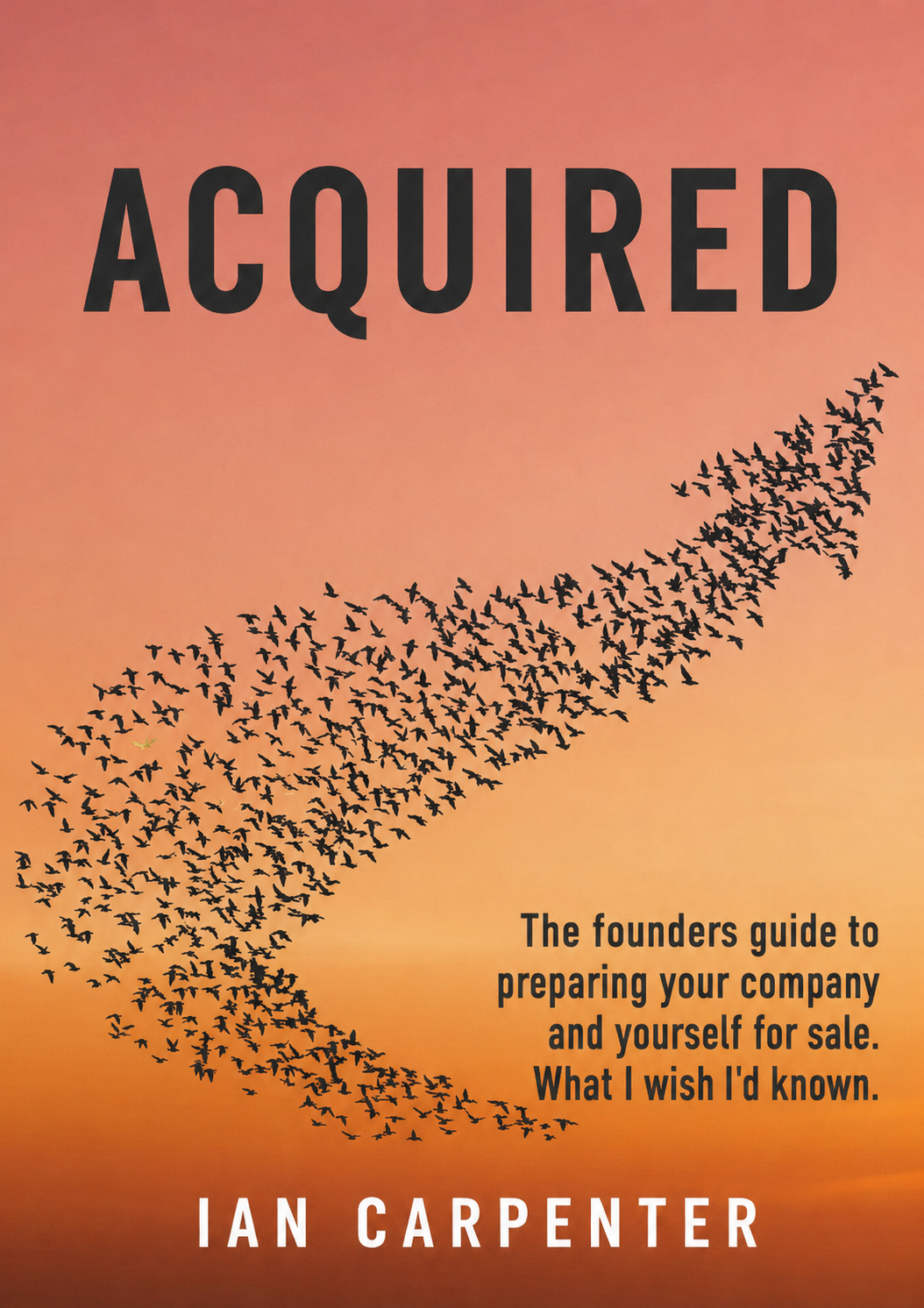
You will sell your business once, maybe twice. The buyer's team does this every week. Acquired, by Ian Carpenter, shows you how buyers value a services firm, what to fix years before one looks, and how to negotiate the cash and earnout terms that decide what lands in your account.

Yes! Rush me a copy — $20
Ebook only · Instant download

What you don't know about the sale you heard about

You already know roughly what a competitor sold for. You've heard the figure at a conference, or from a friend of a friend, and you did the maths on your own business on the drive home.

What you don't know is how much of that figure the founder kept.

You might know someone who spent two years in earnout purgatory while the buyer took apart everything they'd built. You might know someone who got burned in due diligence over a contract they could have fixed three years earlier. The stories come back to you at odd hours, usually alongside a question you haven't answered: "What is this thing actually worth, and what happens to me when I sell it?"

Then come the quieter thoughts. "I'll deal with exit planning when things settle down." "When we hit $10M." "When we hire a CFO." Things never settle down, and the next milestone is always one more year away.

If this sounds familiar, you're not alone, and you're not behind because you're bad at business. You built a firm that pays its people well and keeps clients coming back. That took real skill.

The sale gets judged by one number on a cover page, and that number gets paid out over years you no longer control. Everyone in the room knows this except the founder.

Why the biggest offer is often the worst deal for a founder

Founders chase the headline price, and it's easy to see why. It's the number in the press release, the one your peers will hear, the one that feels like a score for ten years of work.

The trouble starts with how that price gets paid. Take two offers Ian walks through in the book. Offer A is $12M: $7M cash at completion and $5M in an earnout over three years, tied to revenue and EBITDA targets. Offer B is $9M: $8M in cash and $1M tied to a single objective milestone.

Offer A looks bigger. But the day after closing, the buyer sets your budget. They can freeze hiring, change your pricing, reassign your best salesperson, or fold your team into another division and load shared costs onto your P&L. Every one of those decisions is legitimate, and every one can cost you money you thought you'd already earned.

A highly certain $8M is worth more than a nominal $12M with real execution risk. The book calls this risk adjusted value, and once you see deals that way, the cover page stops impressing you.

Why a good advisory team still leaves gaps in your sale

The usual answer is to hire good people. You should. Ian is clear that a strong advisor often earns their fee back many times over, and that the book is meant to sit alongside expert guidance, never replace it.

But look at what each of them is actually checking. Your banker's fee is usually a percentage of deal value, and an advisor pitching for your mandate has every reason to quote you an optimistic number. Your lawyer reviews the wording of the earnout. Whether the targets can be hit under a new corporate parent isn't really the lawyer's job. Your accountant handles the tax.

Due diligence has the same gap, on the buyer's side. It's run by lawyers, accountants and financial analysts. The sales, delivery and support leaders who will inherit your team and clients barely take part. They arrive at completion knowing your metrics and nothing about the people who produced them.

So nobody in the process owns the question that matters most to you: what will you actually keep, and what job have you just agreed to do?

Why I wrote this book

The worst moment in my first business started with a letter from the tax office. We hadn't lodged our returns for three years. I'd trusted someone to do it and never checked. The bill was $1.2 million, with 21 days to pay.

We negotiated a payment plan, chased every lead around the clock, and went back to investors for an emergency raise. The raise saved the company. It also diluted my shareholding, and I'd feel that years later.

In a different year, we lost three contracts worth over $1 million each in a single week. One was a mobile app for a casino chain's high roller VIPs, torn up after eighteen of the casino's employees were arrested in China. Another collapsed when 60 Minutes ran a story on a client and the State Government shut their whole industry down by 9am Monday. None of it had anything to do with our delivery.

Eventually I sold. Nine months, eight signatures. When the transfer came through, my wife sat down next to me on the couch with a bottle of champagne, and I opened my banking app. The champagne stayed unopened. Ten years of work had turned into a single figure, and the figure didn't match the ten years.

Then came the part nobody had warned me about. The acquirer never asked what made our team work. I learned about redundancies across my own delivery team in an all-hands meeting, standing next to the people being cut. Not long after we won a global innovation award from Salesforce for a project I'd sold and architected, I was put on a performance plan ten days before Christmas. I found out I'd been terminated from an email I was copied on.

I trained in Tae Kwon Do and Jiu Jitsu for years. When you break a board, you're taught to aim 15 to 30cm behind it, because if you aim at the surface your hand slows down right at contact. Selling a business works the same way. Founders who aim at completion day stop there, and the deal gets set for that day and paid across years they no longer run.

I wrote Acquired so you can aim past the board.
Why preparing years ahead gets founders a better deal than negotiating harder at the end

Founders who start preparing early get better deals, and the difference between them and everyone else is big.

The reason is simple. Your business gets valued on what a sophisticated buyer believes it can become in their hands, and that belief is built from things you can't fake in three months. A recurring revenue base takes 18 to 36 months of deliberate contract strategy. Taking yourself out of the centre of client relationships is a 12 to 36 month job. Buyers want three years of clean accounts, and the clock only starts when you clean them.

Do that work and the negotiation changes shape. You know which earnout terms you'd refuse before anyone proposes them. You have more than one buyer at the table, so you choose the deal. The multiple you get is earned in advance, and it holds up under scrutiny.

The founder first approach to selling a tech services business

Acquired walks you through the whole arc of a sale, in the order you'll live it: who buys, what they pay for, what to fix, how the process runs, how to negotiate the number you actually receive, and what happens after the money moves.

Every chapter is measured against one question: what does this decision mean for what you keep, and for the life you step into afterwards?

Yes! Rush me a copy — $20
Instant download

The 6 Stages of Selling Your Tech Services Business Well

The whole sale, in the order you'll live it.

01
Know your buyer
Understand what strategic buyers, private equity, rollup platforms and management buy-ins are each paying for, so you can sell to the right one.
02
Understand your valuation
Learn why the same $1M of EBITDA can sell for $3M or $10M, and which drivers raise or cut your multiple.
03
Get acquisition ready
Clean up your financials, contracts and IP, and make the business run without you, starting 12 to 36 months out.
04
Run the deal process
Know all seven stages, from choosing an advisor through due diligence and the SPA, so nothing catches you off guard.
05
Negotiate what you actually receive
Weigh cash against earnout and rollover equity, and write in the protections that keep your money safe after closing.
06
Plan your life after the sale
Prepare for the identity shift, the move from owner to employee, and your eventual exit from the exit, before you sign.

What You'll Discover Inside

01
What each type of buyer is really paying for
Why a listed strategic acquirer will push more of the price into an earnout, and why that tells you what they'll ask for after the first friendly conversation.
02
Why one business sells at 3x and another at 10x
Three firms, each with $5M revenue and $1M EBITDA, and the exact differences that separate the bottom of the range from the top.
03
Where buyers draw the line on client concentration
The percentage at which your biggest client starts raising questions, and the point where it becomes a structural problem most buyers will price against you.
04
How to prove the business runs without you
The four-week test Ian ran before his sale, with the email app deleted, and why it's some of the strongest evidence you can hand a buyer.
05
How working capital changes the cash you get at completion
The working capital peg explained in plain terms, and why founders who don't understand it lose the argument line by line.
06
How to pick an M&A advisor who fits your situation
Why access to buyers and skill at running a process are two different strengths, and why you should ask for a range with reasoning instead of one flattering number.
07
The blind spot in due diligence
Why the people who will run your team after the sale are mostly absent from the investigation, and how to get time with them before you sign anything binding.
08
How to compare a bigger offer with a smaller, safer one
The risk adjusted way to weigh $12M with a heavy earnout against $9M in near-certain cash.
09
The earnout and rollover terms worth fighting for
Why revenue beats EBITDA as a metric, why shorter is safer, why tenure beats performance, and what consent and reporting rights to demand as a minority shareholder.
10
What to decide before completion day
The questions to answer about your first month, your role and your family before the money moves, so you arrive with something to go to.

Is This Right For You?

This is NOT for those who:
  • Sell software products rather than services, since the book is built around the realities of a services firm.
  • Want a tax manual. The book covers the principles and tells you plainly to get specialist advice.
  • Plan to fake a competitive process. Buyers spot it, and the book won't help you try.
  • Expect a premium price in three months with no preparation. Nobody can deliver that.
This is for:
  • The founder of a tech services firm (a CRM or ERP partner, a cybersecurity or cloud services firm, a managed services provider, a DevOps shop) thinking about a sale in the next twelve months or the next five years.
  • Founders already talking to advisors or sitting in due diligence.
  • Founders who aren't sure they'll ever sell, because the same preparation is what gives you the choice to sell or hand the business down.
Yes! Rush me a copy — $20
Instant download

Frequently Asked Questions

Is this just another M&A book?
Most M&A books stop at closing. This one spends a full chapter on what happens after, and another on what happened to Ian when he sold his own business. It's written by a founder who lived the deal, not a banker describing one.
I'm years away from selling. Is it too early?
No. The book's argument is that the best outcomes come from treating preparation as a long-term project. Recurring revenue, management depth and clean accounts all take years to build, and they make the business stronger to run in the meantime.
I've already had an inbound approach. Is it too late?
The book covers that path directly, including what kind of advisor you need when interest has already arrived and how to avoid rushing into exclusivity before the terms are right.
Do I need a finance background to follow it?
No. Terms like adjusted EBITDA, the working capital peg, the LOI and the SPA are explained in plain language with worked examples.
Does it replace my advisors?
No. Ian is clear that understanding plus expert guidance is what produces good outcomes. The book gives you enough knowledge to brief your advisors well and to know which questions they aren't asking.
What if I'm not sure I'll ever sell?
The preparation still pays. A business that runs without you, with clean financials and a spread of clients, is worth more and easier to live with, whether you sell it, keep it, or hand it to family.
Ian Carpenter

Ian Carpenter.

Ian Carpenter has spent 32 years in enterprise software and tech services. He has founded and grown multiple technology and tech services businesses, raised capital, nearly lost a company to a tax bill, and sold a business he spent ten years building.

He has also been on the losing side of an acquisition. He watched an award-winning practice shrink under an owner who never asked what made it work, and he learned about his own termination from an email he was copied on.

That experience is the basis of everything in Acquired. Today Ian runs a consulting practice working with a small number of founders at a time, on the business and on the person who owns it. His view is that a sale should fund a good life, with your health, your purpose and the people you love intact on the other side of it.

Walk Into Your Sale Knowing the Number You'll Keep

Imagine sitting down with a buyer and knowing exactly what they're paying for. You have more than one offer to choose from. You know which earnout terms you'll accept and which you'll refuse. Your best people are protected in the deal, and you already know what you're doing in the first month after completion.

When the money moves, you open the champagne.

Acquired shows you how to get there, starting with the gap you can fix this week.

For founders of tech services businesses

How tech services founders can sell their firm
for a price they still keep three years later

You will sell your business once, maybe twice. The buyer's team does this every week. Acquired, by Ian Carpenter, shows you how buyers value a services firm, what to fix years before one looks, and how to negotiate the cash and earnout terms that decide what lands in your account.

Yes! Rush me a copy — $20
30-day refund · Ebook only · Instant download